A new technical briefing reviews the latest evidence on how trawling, other human activities and climate change affect seabed carbon.
In this new blog, UK and international blue carbon experts highlight the important role of the UK’s seabed in climate mitigation, storing an estimated 240–524 million tonnes in the upper 10 cm alone. They present new evidence on trawling gear - seabed interaction, suggesting that emissions released from trawling, while still significant, are likely lower than previously estimated. The authors also highlight uncertainties linking carbon disturbance from various human activities, carbon reactivity and actual emissions. The findings have highlighted potential trade-offs for management options supporting environmental, clean energy, and food security goals and paves the way for cross sector collaboration and consensus.
By Ruth Parker, Principal Scientist for Biogeochemistry and Blue Carbon Advisor; Carolyn Graves, Monitoring Programme Lead; Catriona Moss, External Communications Officer (Cefas); Marija Sciberras, Associate Professor (Lyell Centre, Heriot Watt University); Lucas Porz, Post Doctoral Scientist (Institute of Coastal Systems, Helmholtz-Zentrum Hereon, Germany); Jan Hiddink, Professor in Marine Biology, (University of Bangor) and Sam Rastrick, Researcher, (Institute of Marine Research, Norway).
The surface seabed beneath England’s waters is home to a vast, hidden store of carbon—one that could play a pivotal role in the UK’s climate change mitigation strategy, storing the equivalent of five times the UK's annual emissions. While knowledge of the importance of this emerging “blue carbon” habitat has grown in recent years, its potential to help mitigate climate change is not yet fully recognised and the seabed remains unprotected for this purpose under international agreements.
Human activities – particularly bottom trawling – have received significant attention in the past due to their impacts on marine biodiversity. More recent studies and subsequent media coverage have focused on trawling effects on seabed organic carbon, with some suggesting that carbon release and emissions associated with this activity is equivalent to annual carbon emissions released from the entire global aviation industry. These figures have often been cited to advocate for the banning of trawling in marine protected areas.
Under the UK government’s Blue Carbon Evidence Partnership, Defra’s marine science agency Cefas has been working with partners to assess and fill critical evidence gaps on the role of the seabed in carbon storage and sequestration. As our understanding of this marine ecosystem grows, a new Cefas/Defra technical briefing —co-authored by over 30 leading national and international experts—reveals a more nuanced picture of how human activities, in particular trawling, interact with seabed organic carbon. This highlights that managing protected areas, and the seabed overall, is more complex than previously thought. 1
To achieve climate goals while safeguarding marine biodiversity, we need science-based solutions that carefully weigh the trade-offs between climate action and nature protection and recovery. We need a more evidence-based conversation around trawling’s true impact on seabed carbon.
How human activities interact with seabed carbon
The top 10 centimetres of English seabed sediments hold between 80 and 104 million tonnes of organic carbon. This carbon comes from both marine sources (plankton, benthos, fish detritus) and terrestrial sources (plant material washed into the sea from river catchments). It has accumulated over decades to centuries, with the largest stores found in muddier, deeper and colder areas, or in sediments with high carbon inputs.
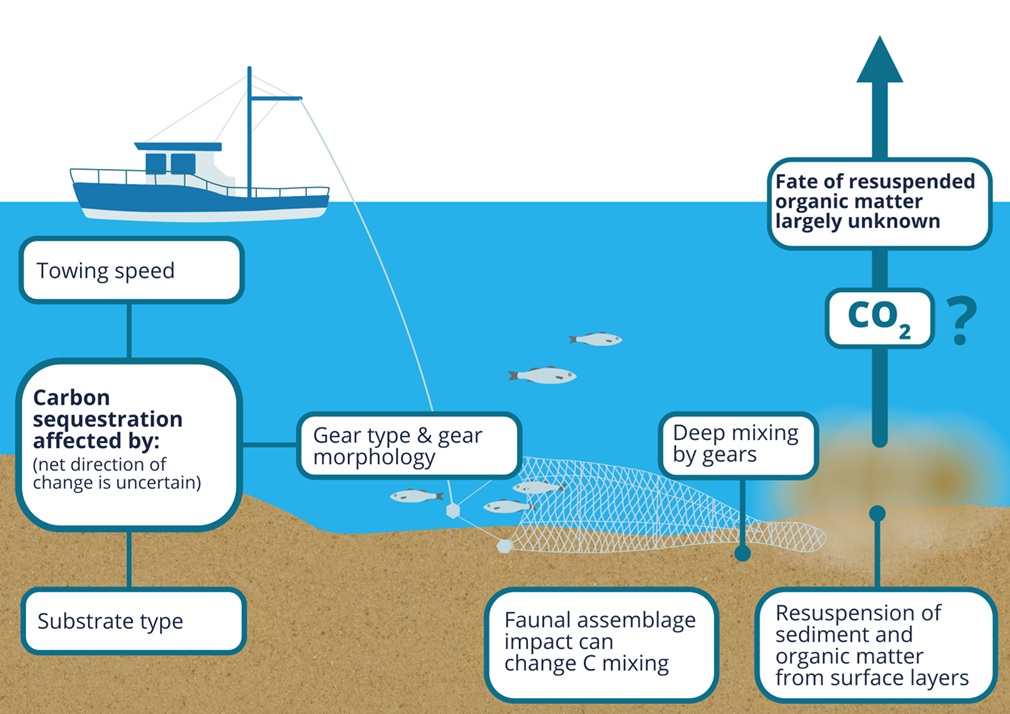
When fishing gear interacts with the seabed, it triggers a cascade of processes. The disturbance causes three main effects: changing the seabed fauna, mixing carbon within the sediment layers, or resuspending it into the water column above where it is displaced and transported to nearby areas (Figure 1). Once disturbed, the fate of this carbon depends critically on how "reactive" it is – essentially, how easily it can be broken down to release carbon dioxide. New Cefas-led research suggests that, depending on location, between 10% and 35% of English seabed organic carbon is reactive enough and will potentially degrade when exposed to oxygen and warmer water temperatures. This is far below earlier estimates for fine sediments of ~70%.
When reactive carbon degrades, it releases dissolved carbon dioxide into the water. Some of this carbon dioxide may eventually reach the atmosphere, contributing to climate change. However, this depends on a complex set of interactions with ocean currents, seasonal temperature changes, and biological processes that can absorb carbon dioxide.
So, in terms of the big question on how much is released: the truth is that our ability to describe and understand seabed carbon risk, largely driven by its assumed reactivity — due to its composition, source and environmental conditions — it is still evolving. As a result, we do not yet have a clear picture of emission rates, a critical evidence gap when trying to assess the impact of human activities.
New evidence on trawling impacts
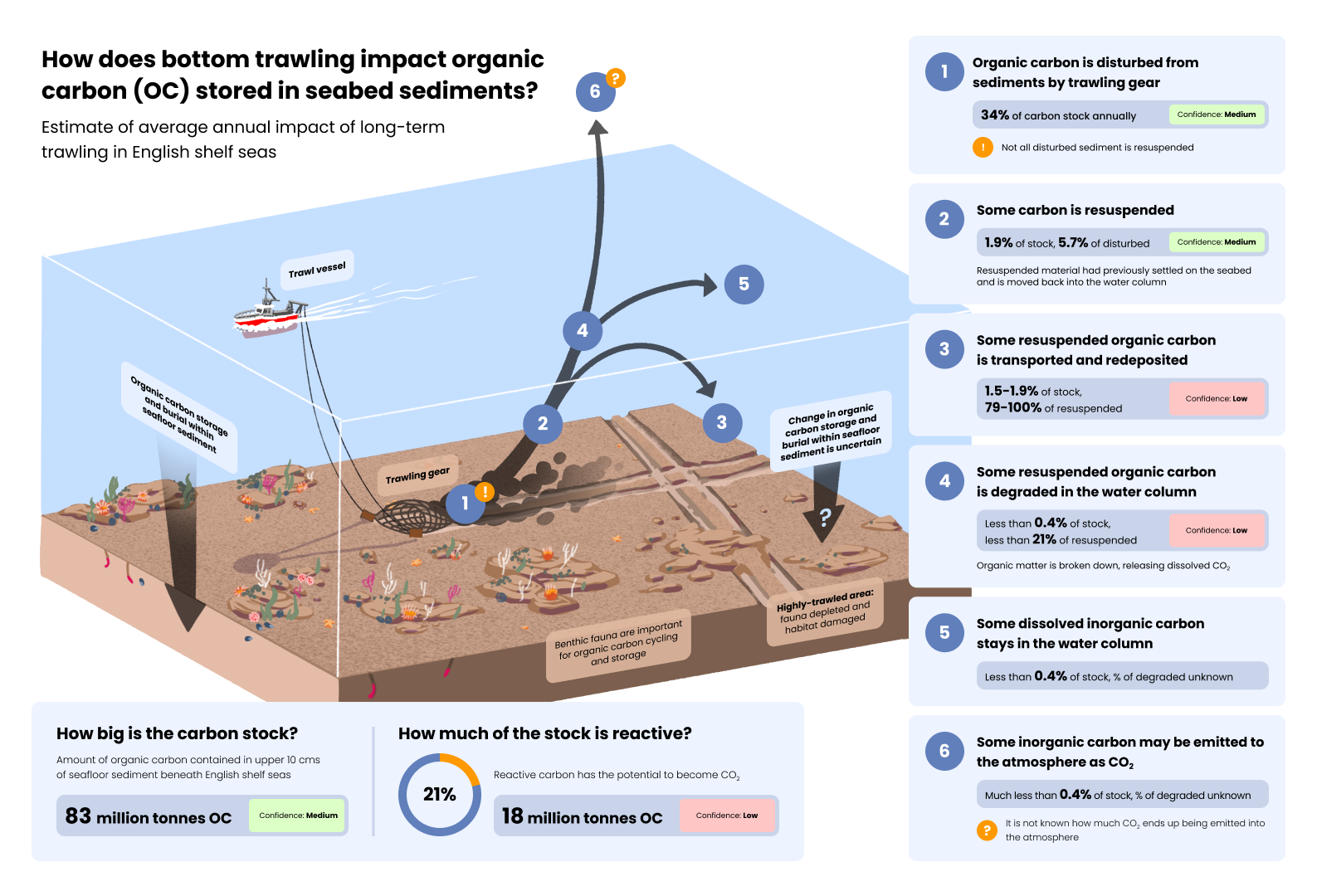
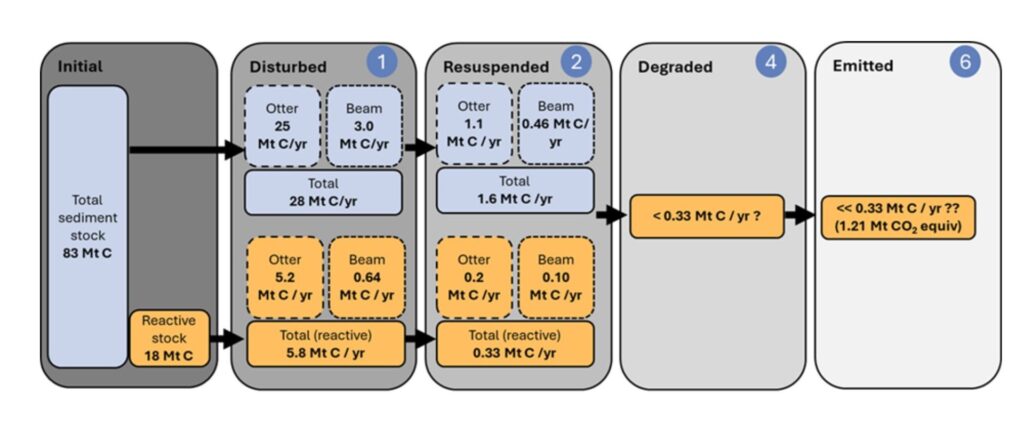
Each year, demersal trawling (otter and beam trawling) disturbs approximately 28 million tonnes of carbon, roughly 35% of the total surface stock in English shelf seas. Figures 2 and 3 illustrate the magnitude of carbon estimates from seabed stock to potential emissions. However, a key finding from our recently published Defra/Cefas technical briefing has fundamentally changed understanding of its impact; only 5.7% is resuspended into the water column (1.6. million tonnes of carbon). To put this figure in context, if all this carbon was degraded and emitted (which is highly unlikely due to processes within the water column), it would be equivalent to the annual carbon dioxide emissions of approximately 4.2 million cars – about 10% of all vehicles on UK roads.
This matters considerably. Although this number is still significant, for years, studies often assumed all carbon disturbed by trawling gear entered the water column. The developing evidence now shows that depending on gear type, between 1% and 21% of disturbed carbon is resuspended into the water column. Furthermore, depending on the seabed type, not all resuspended carbon is reactive enough to degrade, only between 10 and 35% of the seabed carbon is classed as being ‘reactive’.
Taking into account both factors – that only a small proportion of disturbed carbon is resuspended, and that only a proportion of this is reactive – actual carbon dioxide emissions that contribute to climate change are likely to be considerably lower than previously assumed.
This improved understanding represents a significant development in the evidence base. Whilst trawling does interact with substantial amounts of seabed organic carbon, the processes involved are more complex and the potential carbon emissions smaller than earlier estimates suggested.
Infrastructure development
Beyond trawling, a range of infrastructure and human activities affect seabed carbon, such as oil and gas operations, power and telecommunications cables, pipelines, offshore wind farms, carbon capture and storage facilities, aggregate extraction and dredging – disposal operations.
Whilst trawling repeatedly disturbs the top layers of sediment across vast areas, infrastructure development can penetrate much deeper, well below the top 10 centimetres. The impacts are therefore much more intense and the disturbance reaches deeper carbon stores that may have been accumulating for centuries and are potentially more degraded than surface sediments. However, their impacts are much more managed thorough construction licensing. Additionally, disturbances need to be considered over comparable timeframes (for example, the 20-year life span of a wind turbine compared to a single trawl that passes in a few seconds).
Understanding carbon impacts across the full lifecycle of infrastructure – from construction through operation to decommissioning – is particularly important and provides opportunities to consider carbon in project planning and design decisions. Recent reviews undertaken by Cefas and Essex University on behalf of the Crown Estate (TCE) supporting TCE’s role in managing sedimentary carbon across its Marine and Coastal estate, have highlighted the low confidence of evidence base around infrastructure impacts on seabed carbon. However emerging evidence (Porz et al., 2025) are beginning to highlight the relative magnitude of different activities on seabed carbon disturbance.
Climate change
Climate change is itself potentially affecting seabed carbon systems in multiple ways due to gradual shifts in baseline ocean conditions, such as water column hydrography, temperature, oxygen levels and carbon inputs, as well as through extreme events, such as storms and marine heatwaves.
Warmer seas alter the productivity, abundance and behaviour of marine life and plankton communities, changing how much organic carbon settles to the seabed. Simultaneously, higher temperatures accelerate the breakdown of carbon already in sediments. Marine heatwaves add further stress, with short-term spikes in temperature capable of rapidly accelerating the breakdown of carbon in ways we're only beginning to understand. Additionally, the predicted increase in the magnitude of storms could lead to expansion of areas where seabed carbon stores are exposed to larger natural disturbance pressures, including resuspension.
The combined effects of climate change and human activities can exacerbate carbon impacts. If trawling or construction disturbs carbon when sea temperatures are higher – particularly in shallow areas during spring and summer when temperatures can reach 10-18°C – the risk of degradation of carbon stores and associated emissions increases substantially.
Areas currently protected by cold temperatures face particular risk. The northern North Sea and other deep, cold shelf areas have accumulated carbon over decades partly because low temperatures slow degradation. As these areas warm, previously stable organic carbon stores become vulnerable. If warming combines with increased human activity in these regions – whether from fishing, infrastructure, or other pressures – the impact could be substantial.
Recent work funded by the Natural Environment Research Council (NERC) highlights the potential pressure from marine heatwaves at the seafloor but despite advances in our understanding, we lack predictive models with sufficient skill to forecast these changes or estimate climate change's full impact on seabed carbon storage and burial. This is a key area for evidence development.
The relationship between biodiversity and carbon
Although not a key focus of our recent technical briefing, the relationship between biodiversity and seabed carbon is important to highlight here. Seabed fauna (animals ranging from a few cm to tiny, microscopic animals that live in the seabed) play an important role in how seabed carbon is processed and stored. They do this by mixing sediments and oxygenating the water through movement and biological activity, particularly in muddy sediments. While fauna can enhance carbon stocks by drawing carbon down into the sediment, increased biological activity can also speed up its degradation. Scientists are only now beginning to understand how these competing processes affect long-term carbon storage. We don’t yet know how human activities affect this balance, or what happens when biodiversity is protected or allowed to recover. Emerging evidence suggests that biodiversity recovery may increase carbon degradation and could reduce overall carbon stores. This highlights the important potential trade-off between biodiversity and carbon outcomes.
Management options: How best to protect seabed carbon?
So, based on current evidence, what are the best options for protecting and managing seabed carbon?
Our latest briefing suggests it’s not straight forward. Effective management depends on understanding the opportunities and trade-offs involved in managing ocean resources in specific locations. Recent Cefas research has developed a framework for evaluating the risks and impacts of different management options on biodiversity, fishing, offshore wind and seabed carbon in the North Sea. While region-specific differences in seabed carbon changes at large scales were difficult to detect, further research indicates that banning trawling in areas with high levels of ‘reactive’ carbon could help protect valuable organic carbon stores. For example, a recent study found that trawl bans implemented in “Carbon Protection Zones” (areas with high amounts and/or easily degradable carbon) were much more effective in terms of reducing carbon degradation than in marine protected areas selected for biodiversity purposes.
However, such measures are not without risk. Banning activity in one area may shift activity to other locations where it causes greater harm, potentially increasing overall carbon disturbance, particularly if fishing activity moves into more sensitive carbon areas.
This risk is particularly relevant in long-established trawled areas, where seabed carbon is often already degraded and less reactive. Restricting activity in these areas may offer limited carbon benefits, while negatively impacting local livelihoods. At the same time, displacing fishing activity into areas that have so far experienced limited disturbance, could also lead to potential increases in carbon release. Effective management therefore requires careful consideration of trade-offs and impacts across local and regional scales to avoid unintentional outcomes of spatial protection measures.
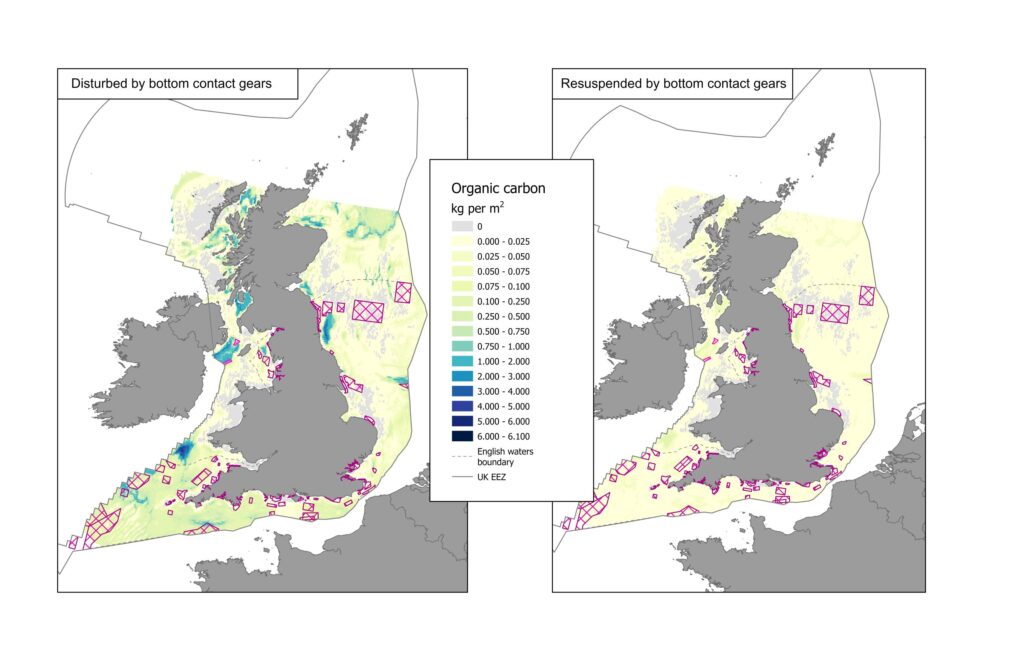
It's also important to recognise that the UK's marine protected area (MPA) network was originally designed to protect biodiversity and not focused on carbon stocks. As already noted, the evidence suggests a complex relationship between biodiversity and carbon storage—areas with higher biodiversity can sometimes have lower carbon stores, as macrofauna and other small seabed creatures can accelerate the degradation of organic matter. Cefas research has found that the majority (67%-81%) of the UK's seabed carbon actually lies outside the offshore MPA (MCZ) network, some of which is under significant trawling pressure (Figures 4). This highlights an important consideration: measures designed to protect biodiversity don't automatically result in carbon protection. Managing seabed carbon effectively will depend on different or additional approaches tailored specifically to carbon storage objectives.
The location, the type of activity and how these interact with environmental conditions all need to be considered to both understand and manage these impacts. For example, the risk of carbon degradation increases with water temperature. Activities that disturb sediment in shallow waters which remain well mixed (less than 30 - 40 metres deep) during spring and summer, when temperatures reach 10–18°C, pose the greatest risk. Scheduling activities during cooler periods could help reduce potential emissions. Additionally, modifications to fishing gear, such as lighter equipment or raised footropes designed to protect biodiversity can help minimise carbon impacts.
Finally, human activities also change the communities of creatures living in and on the seabed – organisms that play important roles in processing and storing carbon. The full picture of our impact requires understanding these biological changes alongside the physical disturbance to understand the overall effect on pressure changes on carbon storage.
Filling the evidence gaps
Human activities are disturbing seabed carbon at significant scales; with potential climate implications we are only beginning to understand. As part of the Government’s UK Marine Strategy, protecting biodiversity and seafloor integrity are seen as key indicators for a healthy ocean. The question for policymakers is how to achieve this in a way that delivers for nature, people and the economy. Going forward, there is a need to address some of the key evidence gaps to help manage human activities in ways that protect seabed carbon storage and maximise its climate benefits.
Building on Cefas previous research, three priorities areas are now emerging:
First, we need a clearer picture of where seabed carbon sits around the UK. This means understanding not just where and how much there is, but also how reactive and vulnerable it is to disturbance. A key question is whether studying the top 10 centimetres of seabed sediment really tells us enough about a what is happening deeper down? Mapping seabed carbon vulnerability will be vital for understanding how different pressures may influence carbon release and burial, enabling us to identify the most effective management approaches and trade-offs. This work will build on a recent blue carbon ‘toolbox’ of methods to help scientists understand where carbon stocks may be at risk and where management of carbon in seabed sediments may contribute to climate change mitigation.
Second, we must improve our understanding of how carbon changes and degrades in response to different human activities and environmental factors including climate change. This means continuing to assess the impact of trawling on the relationship between biodiversity and seabed carbon storage, and further ‘ground truthing’ of impacted areas to improve our understanding trawling/infrastructure impacts. Further work could focus on observational studies across a gradient of trawling activities in different shelf areas, potentially focused on fishing grounds in the southwest channel and Celtic Sea. Improved understanding of the within water column processes that alter and control the amount of carbon eventually released to the atmosphere (steps 5 and 6 in figure 2) will also be key.
Third, we need predictive models to assess management scenarios and their trade-offs for carbon but also biodiversity and fishing or energy sectors, under climate change. This involves work to examine differing life cycle/activity distribution scenarios and options to minimise carbon disturbance or risk. This may include trawling gear modification carbon effects and sector - sector interactions (gear switching or displacement) from infrastructure placements or life-cycle decisions (e.g., leave in place vs remove). This also informs understanding of the value of seabed sediment as an ecosystem service and potential natural capital accounting. Cefas Research has shown that degradation of these climate regulation services could cost the UK economy up to £10 billion over 25 years through lost ecosystem benefits. A follow up paper explored the need for new accounting guidance and governance frameworks to manage carbon in shelf seas. Future work will focus on the value of seabed carbon ecosystem services and the feasibility of their integration into carbon credits schemes.
Whilst trawling has been a focus of our recent research, it represents just one of many pressures affecting seabed carbon. This technical briefing and forthcoming work will be an essential platform in supporting policymakers to develop effective management approaches including the strategic use of management measures such as Marine Protected Areas, to aid the protection and recovery of these vital blue carbon systems.
Going forward, the research aims to develop a nationally standardised approach to measuring and monitoring seabed carbon as well as assessing impacts from differing human and environmental pressures. This work in the UK will be critical to inform ongoing international discussions on this topic, for example at ICES and OSPAR. Working in partnership with academic institutions, industry, and environmental organisations both within the UK and internationally will be crucial to understanding seabed carbon dynamics, strengthening the confidence in the evidence base, and developing consensus on what management measures are needed to allow nature recovery of seabed sediment habitats whilst balancing Net Zero, Food and Energy security objectives.
- This technical briefing focuses on the evidence base for English waters. However, the general principles outlined here are likely to be applicable to the seabed of north-west Europe. ↩︎
- This work focuses on estimating the carbon amounts resuspended into the water column. The net effect of resuspension and other processes (organic carbon relocation or mixing to depth and changes in benthic fauna) are not quantified here but covered within the evidence review. ↩︎